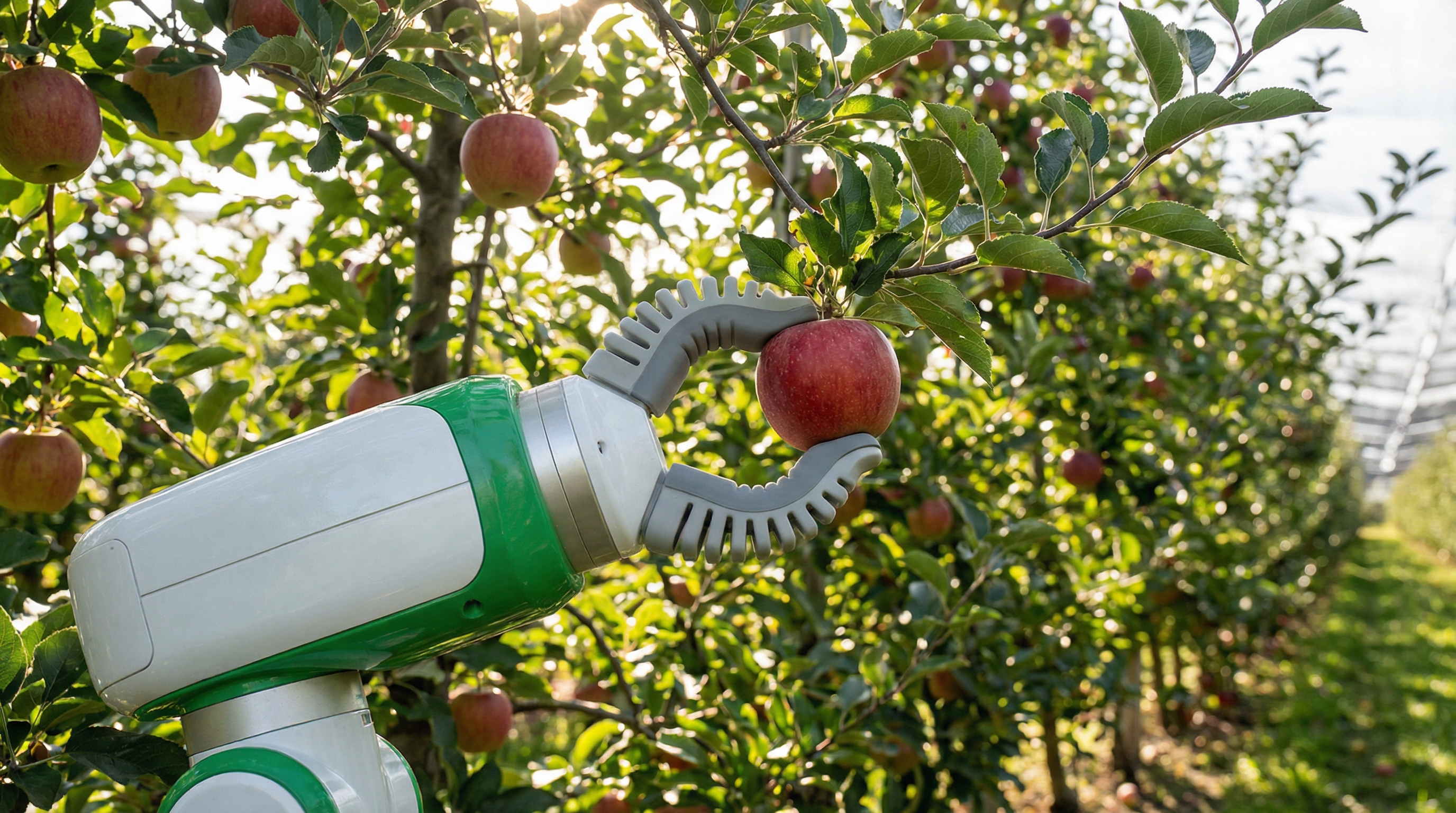
Autonomous robotic harvesters with articulated picking arms working across orchard rows at dawn

The Harvest Environment

Autonomous robotics, fleet orchestration, and AI-optimized labor converge into a single command layer. Zooberry coordinates robotic pickers, autonomous transport carts, and human crews from one real-time operational map—so every piece of fruit is picked at peak quality with minimal waste and maximum throughput.

Real-time operational map showing GPS positions of autonomous robotic harvesters, transport carts, and tractor units across orchard blocks
Fleet Orchestration

Orchard Fleet Command

A universal API architecture—exposing both REST and gRPC endpoints—that abstracts away the proprietary protocols of every robot brand and translates them into a single, unified command surface. Operators see one map, one queue, and one telemetry dashboard regardless of how many OEMs are running in the orchard.

Supported Platforms

  • Tevel Picking Drones — Tethered flying autonomous robots (FARs) that navigate canopy gaps and pick fruit with suction-cup end effectors. Zooberry sends pick-zone polygons and receives per-fruit GPS telemetry over Tevel's native API.
  • Burro Autonomous Carts — Self-driving orchard transport carts that follow pickers and deliver full bins to staging areas. Integrated via REST API; Zooberry manages route assignments, traffic deconfliction, and charge-cycle scheduling.
  • John Deere 8R Autonomous Tractors — Level 3 autonomous tractors for mowing, spraying, and orchard-floor operations. Zooberry communicates through the John Deere Operations Center API, pushing field boundaries and task prescriptions.
  • Advanced.Farm Robotic Harvesters — Full-size robotic apple harvesters with multi-arm picking arrays. Controlled via a gRPC stream that accepts row-level missions and returns per-bin yield and quality metrics in real time.
  • Custom OEM Integrations — A Universal SDK with adapters for ROS 2, MQTT, CAN bus, and proprietary serial protocols. Any Level 2–4 autonomous platform can be onboarded in days, not months.

Real-Time Operational Map

  • GPS Positions — Sub-meter RTK-corrected positions for every machine, refreshed at 10 Hz. Pan and zoom across the entire orchard in a browser or on a rugged tablet mounted in the foreman's ATV.
  • Task Assignments — Color-coded overlays show which rows are queued, in-progress, or completed. Click any machine to see its current mission, estimated time to completion, and next assignment in the queue.
  • Battery & Fuel Status — Unified energy gauge for electric and diesel units. Predictive models estimate remaining operating time based on current workload and terrain, triggering automatic return-to-charge or refuel alerts.
  • Obstacle Avoidance Zones — Geo-fenced exclusion areas around irrigation infrastructure, personnel, and public roads. LiDAR and stereo-vision data from each machine feeds a shared obstacle map updated every 500 ms.

Mission Planning

  • Drag-and-Drop Row Assignments — Assign rows to individual machines or machine groups by dragging them on the map. The planner auto-calculates travel time, turning radius, and overlap avoidance.
  • Priority Queuing — Flag high-value or time-sensitive blocks (e.g., Honeycrisp at optimal Brix) so the fleet services them first. Lower-priority blocks backfill automatically when capacity is available.
  • Dynamic Re-routing — When a machine goes offline (flat tire, low battery, sensor fault), the orchestrator redistributes its remaining rows across active machines within 30 seconds, minimizing downtime impact.

Telemetry Dashboard

  • Picks per Hour — Per-machine and per-block throughput metrics, benchmarked against historical averages and manufacturer specs.
  • Fruit Damage Rate — Percentage of picked fruit with bruise, puncture, or stem-pull defects, measured by inline quality cameras and reported in real time.
  • Machine Uptime — Calculated as productive picking time divided by total deployed time. Trend lines reveal patterns—e.g., downtime spikes after 6 hours suggesting a maintenance window.
  • Maintenance Alerts — Predictive models flag components approaching failure thresholds: gripper finger wear, drive belt tension, hydraulic pressure drops. Alerts route to the mechanic's mobile device with part numbers and repair instructions.
Close-up of AI-guided robotic gripper with RGB and depth cameras evaluating apple ripeness before selective pick
Computer Vision + Robotics

Selective Harvest Protocol

Not every fruit on the tree is ready at the same time. The Selective Harvest Protocol equips robotic grippers with multi-modal sensing and a configurable harvest spec, ensuring that only fruit meeting your exact quality standard is picked on each pass—eliminating the waste and rework of traditional strip-harvesting.

Computer Vision on Robotic Grippers

  • RGB + Depth Camera at 30 fps — Each end effector carries a synchronized stereo pair: a 12 MP RGB sensor for color analysis and a structured-light depth sensor for 3D pose estimation. The dual stream runs at 30 frames per second, providing enough temporal resolution to track fruit even as the arm swings through the canopy.
  • On-arm Edge Inference — A compact NVIDIA Jetson Orin NX module mounted on the arm processes each frame in under 33 ms, running the detection, segmentation, and classification pipeline entirely on-device with no network round-trip.

Fruit Evaluation Pipeline

  • Color Segmentation — Pixel-level HSV analysis calculates the percentage of red, blush, or variety-specific target color coverage across the visible surface of each fruit. For bicolor varieties like Honeycrisp, the model distinguishes between desirable red blush and sunburn discoloration.
  • Size Estimation — Depth data triangulates fruit diameter in millimeters with +/- 2 mm accuracy. Under-size fruit (below the variety's pack-out threshold) is left on the tree for a later pick pass.
  • Blemish Detection — A convolutional neural network trained on 120,000+ labeled images identifies hail damage, insect stings, sooty blotch, flyspeck, russet, and mechanical scuffing. Each blemish is classified by type and quantified as a percentage of surface area.
  • Ripeness Index via NIR Spectroscopy — A miniaturized near-infrared spectrometer (900–1700 nm) mounted alongside the camera measures internal quality indicators: starch-iodine index, soluble solids (Brix), and firmness (via light scattering). These readings feed a composite ripeness index calibrated per variety.

Configurable Harvest Spec

Growers define exactly what constitutes a pickable fruit via a JSON instruction pushed to every robot in the fleet:

{
  "variety": "Honeycrisp",
  "min_red_pct": 60,
  "min_diameter_mm": 70,
  "max_blemish_pct": 5,
  "min_brix": 12.5,
  "max_firmness_lbf": 18,
  "min_firmness_lbf": 13,
  "starch_index_range": [2.0, 4.5]
}

The spec can be updated mid-harvest from the Fleet Command dashboard. Within 10 seconds, every gripper in the orchard recalibrates its pick/pass decision boundary.

Gentle Handling

  • Pneumatic Soft-Grip Fingers — Silicone-membrane fingers inflated to precisely controlled pressure (0.3–0.8 bar depending on fruit firmness). The contact patch distributes force evenly, preventing point-load bruising.
  • 6-Axis Articulated Arm — Full six-degree-of-freedom articulation allows the gripper to approach from below, beside, or above the fruit—whichever angle minimizes stem pull and contact with adjacent fruit or branches.
  • <1% Bruise Rate — In field trials across 500,000+ picks, the pneumatic soft-grip system achieved a bruise rate of 0.7%—significantly below the 3–5% industry average for hand-picking.

Real-Time Quality Feedback Loop

  • Continuous Quality Monitoring — Every picked fruit is photographed post-pick by a second camera inside the collection funnel. If the post-pick quality audit detects an uptick in bruising or stem damage, the system triggers an automatic adjustment cycle.
  • AI Adjusts Gripper Pressure — The reinforcement learning controller reduces pneumatic pressure by 0.05 bar increments and observes the effect over the next 50 picks, converging on the optimal pressure for current conditions (fruit firmness, temperature, humidity).
  • Approach Angle Optimization — If stem-pull defects increase, the motion planner shifts to a twist-and-lift detachment pattern rather than a direct pull, reducing stem damage by up to 40%.
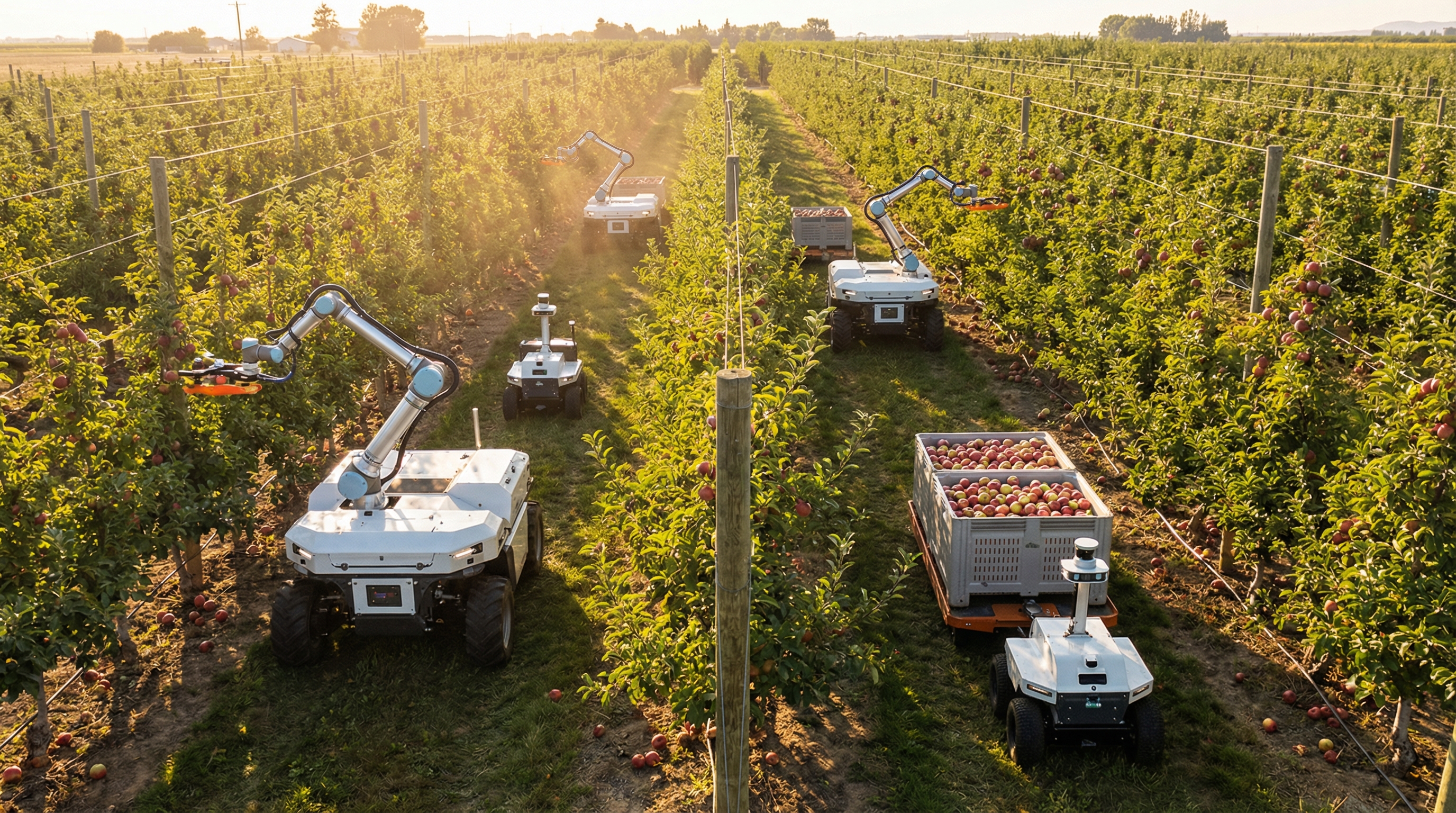
Autonomous bin sleds transporting full apple crates to cold storage staging area with IoT weight sensors visible
Reinforcement Learning + IoT

Smart-Bin AI Logistics

The fastest robotic picker in the world is useless if it has no empty bin to fill. Smart-Bin AI Logistics eliminates the single largest source of harvest downtime—waiting for bins—by predicting demand, dispatching autonomous transport, and routing full bins to cold storage with zero human coordination.

Predictive Bin-Fill Model

  • Reinforcement Learning Engine — A deep Q-network trained on historical pick-rate data, fruit density maps, and per-machine throughput curves predicts the exact minute each bin will reach capacity. The model updates its predictions every 60 seconds as real-time pick data streams in.
  • Per-Picker and Per-Robot Granularity — Human crews and robotic units operate at different speeds and patterns. The model maintains individual throughput profiles so a fast hand-picker on Row 14 gets a fresh bin before a slower robot on Row 22, even if the robot started first.

Autonomous Sled Dispatch

  • Pre-Positioned Empty Bins — Based on the fill-time forecast, the orchestrator dispatches autonomous Burro carts carrying empty bins 2–3 minutes before each picker or robot needs one. The cart arrives, drops the empty, and hooks the full bin—all without the picker breaking stride.
  • Swap Time Under 45 Seconds — Bin placement pads with alignment guides allow the cart to execute a drop-and-hook maneuver in under 45 seconds, compared to the 3–5 minute forklift swap in traditional operations.

Traffic Control

  • Row-End Congestion Prevention — The traffic controller reserves time slots for cart passage at row ends, preventing the pile-ups that occur when multiple carts converge on the same intersection simultaneously.
  • Staging Area Management — Dedicated queuing zones with capacity limits ensure carts do not block access roads. When a staging area reaches 80% capacity, inbound carts are automatically redirected to the nearest alternate zone.
  • Priority Lanes — High-priority lanes are reserved for carts carrying premium-grade fruit destined for immediate cold storage, ensuring that time-sensitive loads (e.g., cherries, soft pears) reach refrigeration within the target window.

Full-Bin Routing to Cold Storage

  • Shortest-Path Calculation — A graph-based routing engine computes the fastest path from the picker's location to the cold storage intake dock, accounting for terrain grade, surface condition, current traffic, and dock queue depth.
  • Dock Scheduling — Arrival times are coordinated with the receiving crew's unload capacity so carts do not idle at the dock. The system staggers arrivals in 90-second intervals to maintain continuous throughput.

IoT Weight Sensors & Real-Time Yield Tracking

  • Per-Bin Load Cells — Industrial strain-gauge sensors embedded in each bin pallet measure gross weight at 1 Hz, accurate to +/- 0.2 kg. The weight stream feeds the fill-prediction model and the yield dashboard simultaneously.
  • Yield per Row, per Picker — Real-time leaderboards show cumulative pounds harvested broken down by orchard block, row, and individual picker or machine. Growers can spot under-performing rows (possible pest damage, irrigation failure) within minutes.
  • Automatic Tare & Calibration — Sensors auto-tare on empty-bin detection and self-calibrate against a reference weight every 100 cycles, maintaining accuracy across wet, muddy, and dusty field conditions.

Labor Cost Impact

  • 15–25% Reduction in Harvest Labor Cost — Independent time-motion studies show that pickers spend 18–30% of their paid time waiting for empty bins, walking to staging areas, or idling during forklift swaps. Smart-Bin AI eliminates virtually all of this unproductive time, translating directly into cost savings of $1,200–$2,800 per acre per season for high-density apple orchards.
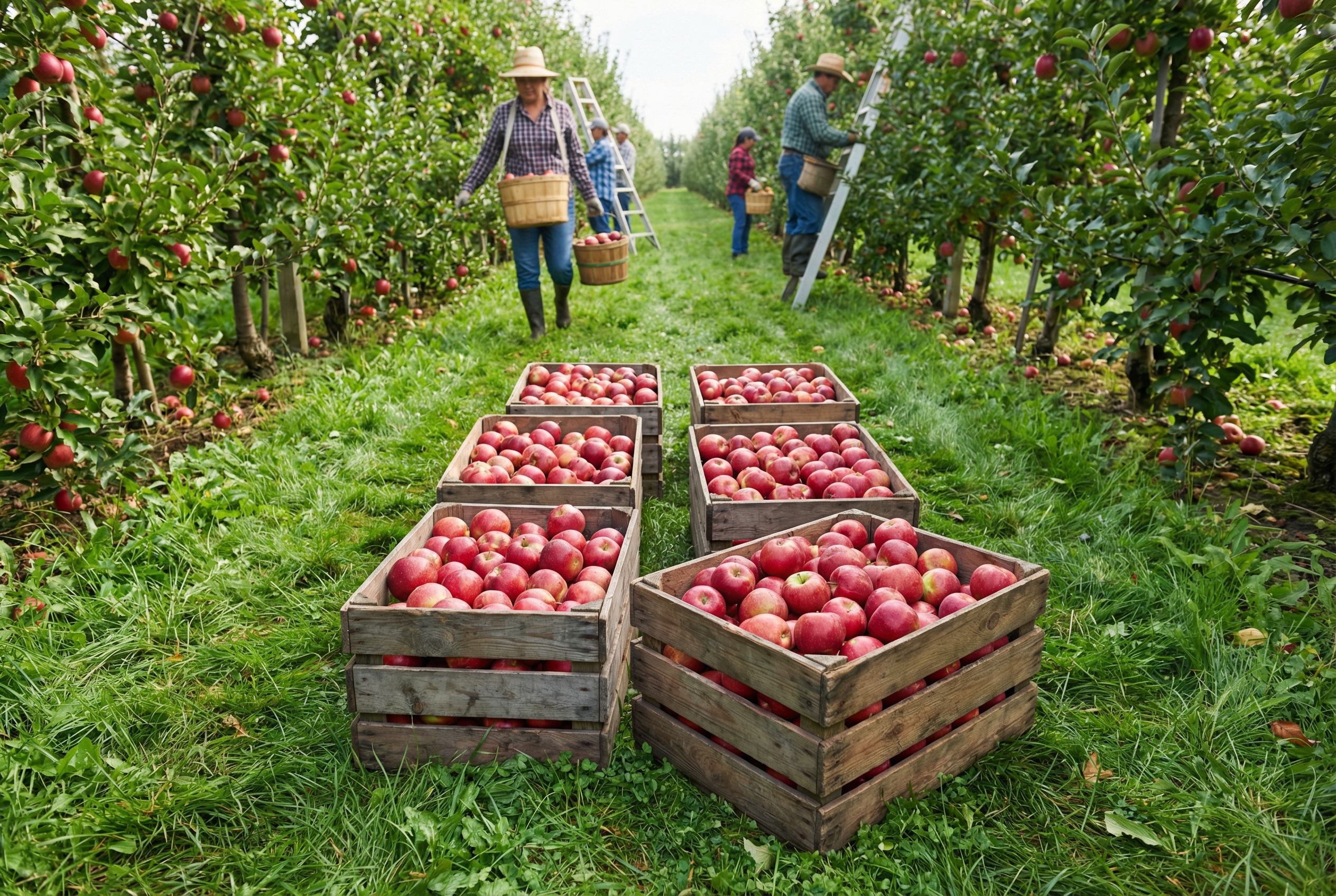
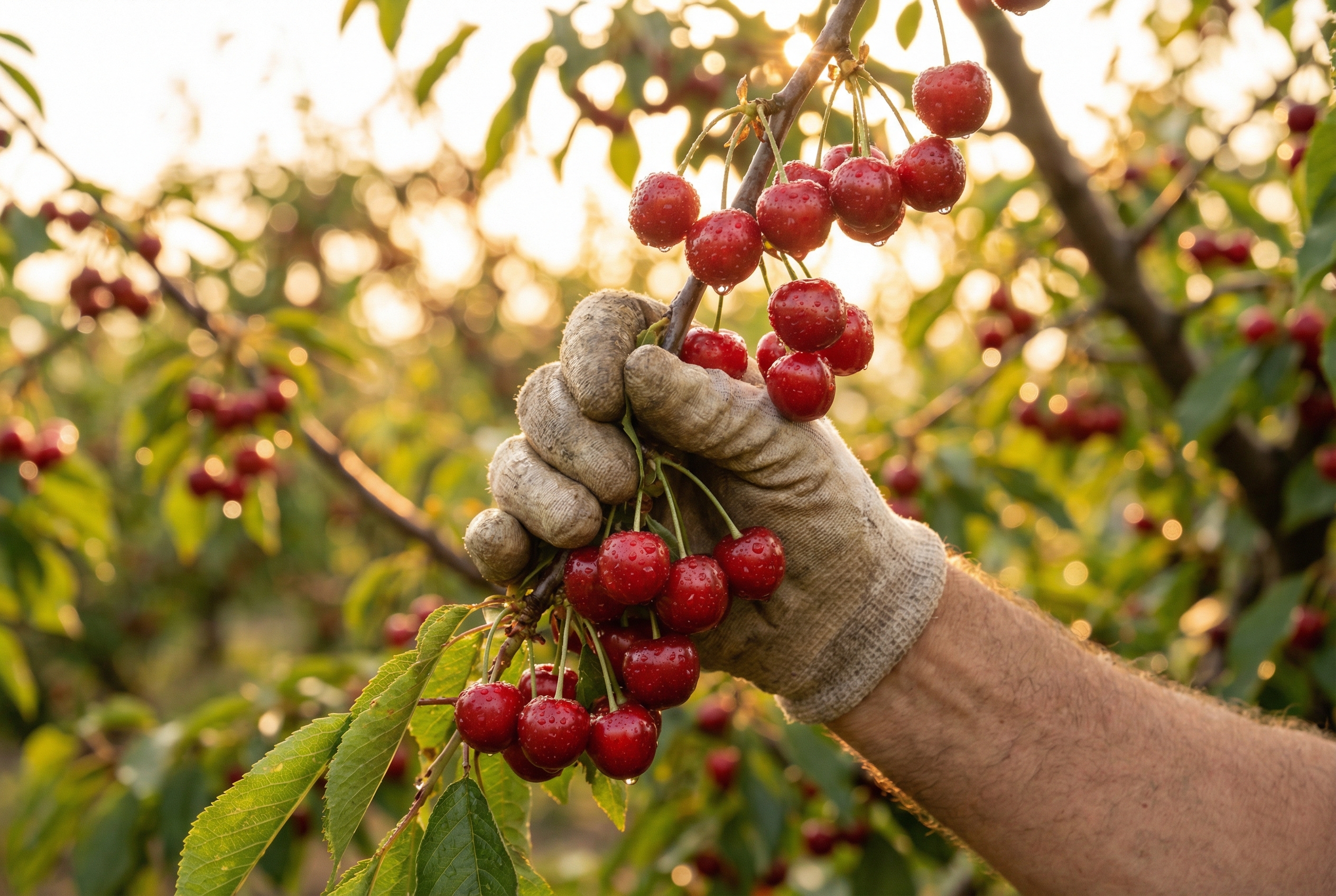
Coordinated harvest crew working alongside autonomous equipment in commercial cherry orchard
AI Compliance + Automation

H-2A Autopilot Agent

The H-2A temporary agricultural worker program is essential for most commercial orchards—and notoriously complex to administer. The H-2A Autopilot Agent uses AI to automate the entire lifecycle: from initial job order filing through payroll compliance, housing audits, and DOL reporting. What used to consume 200+ hours of administrative time per season now runs on autopilot.

AI Document Generation

  • ETA Form 9142A & Appendix A — The agent pre-fills temporary labor certification applications using your orchard profile, historical acreage data, and crop-calendar dates. It validates every field against current DOL requirements before submission, flagging inconsistencies for human review.
  • Job Orders — Automatically generates State Workforce Agency (SWA) job orders with correct SOC codes, wage rates, job descriptions, and working conditions. The AI ensures language matches DOL audit-safe templates while accurately reflecting your specific operation.
  • Housing Attestation — Generates OSHA-compliant housing attestation documents, cross-referencing your housing inventory (beds, square footage, cooking facilities, sanitation) against the number of workers requested. Flags capacity shortfalls before you file.
  • Transportation Plans — Calculates inbound/outbound transportation costs, generates reimbursement schedules, and produces compliant transportation plan documents that meet DOL's "most economical and reasonable" standard.

Compliance Monitoring

  • Wage Rate Checks — Continuously monitors that all piece-rate and hourly earnings meet or exceed the Adverse Effect Wage Rate (AEWR), the prevailing wage, and the applicable state/federal minimum wage—whichever is highest. Alerts fire the instant any worker's effective hourly rate drops below the threshold.
  • AEWR Update Tracking — The agent subscribes to DOL AEWR publications and automatically updates payroll configurations when new rates take effect, preventing the most common H-2A audit finding.
  • Housing Inspection Scheduling — Tracks pre-occupancy and periodic inspection requirements, schedules inspections with certified inspectors, and stores signed inspection reports in the compliance vault for instant retrieval during audits.
  • Three-Quarter Guarantee Tracking — Monitors each worker's cumulative hours against the three-quarter guarantee requirement, alerting managers when shortfalls are trending so they can reassign workers before the contract period ends.

Worker Matching

  • Vetted Labor Contractor Network — The agent connects to Zooberry's network of licensed H-2A labor contractors and recruitment agencies. It matches your crop type, season window, and crew-size requirements against contractor availability and track record.
  • Skill-Based Crew Composition — The matching algorithm considers worker experience (apple vs. cherry vs. pear), physical fitness assessments, and prior season performance scores to assemble crews optimized for your specific operation.
  • Return Worker Prioritization — Workers who performed well in previous seasons are flagged for priority re-hire, reducing training time and improving Day 1 productivity.

Payroll Automation

  • Piece-Rate Calculation — Integrates directly with Smart-Bin IoT weight sensors. Each picker's harvest weight is automatically converted to earnings at the agreed piece rate, with real-time running totals visible on the worker's mobile app.
  • Hourly & Overtime Compliance — For hourly workers, the system enforces state-specific overtime rules (e.g., California's daily overtime after 8 hours, weekly after 40 hours) and applies the correct rate automatically.
  • Piece-Rate Hourly Floor — When a piece-rate worker's effective hourly earnings fall below the AEWR, the system automatically tops up the difference and documents the adjustment for DOL compliance records.
  • Multi-State Payroll — For operations spanning multiple states, the agent handles state tax withholding, workers' compensation insurance rate differences, and varying labor law requirements without manual configuration.

Fleet Technical Specifications

Every autonomous platform supported by Zooberry's Orchard Fleet Command, with integration method, autonomy level, and primary use case.

Platform Type Autonomy Level Integration Use Case
Tevel Drone L4 — Full Autonomy Native API Selective Fruit Picking
Burro Cart L4 — Full Autonomy REST API Bin Transport & Logistics
John Deere 8R Tractor L3 — Conditional Autonomy JD Operations Center Spraying & Mowing
Advanced.Farm Robot L4 — Full Autonomy gRPC Multi-Arm Fruit Picking
Custom OEM Any L2–L4 — Configurable Universal SDK (ROS 2, MQTT, CAN) Configurable per Operation

Deploy autonomous harvest fleets on your orchard.

Join the founding cohort of commercial growers running Zooberry's robotic picking, smart-bin logistics, and AI-optimized labor on their orchards.

Get Early Access