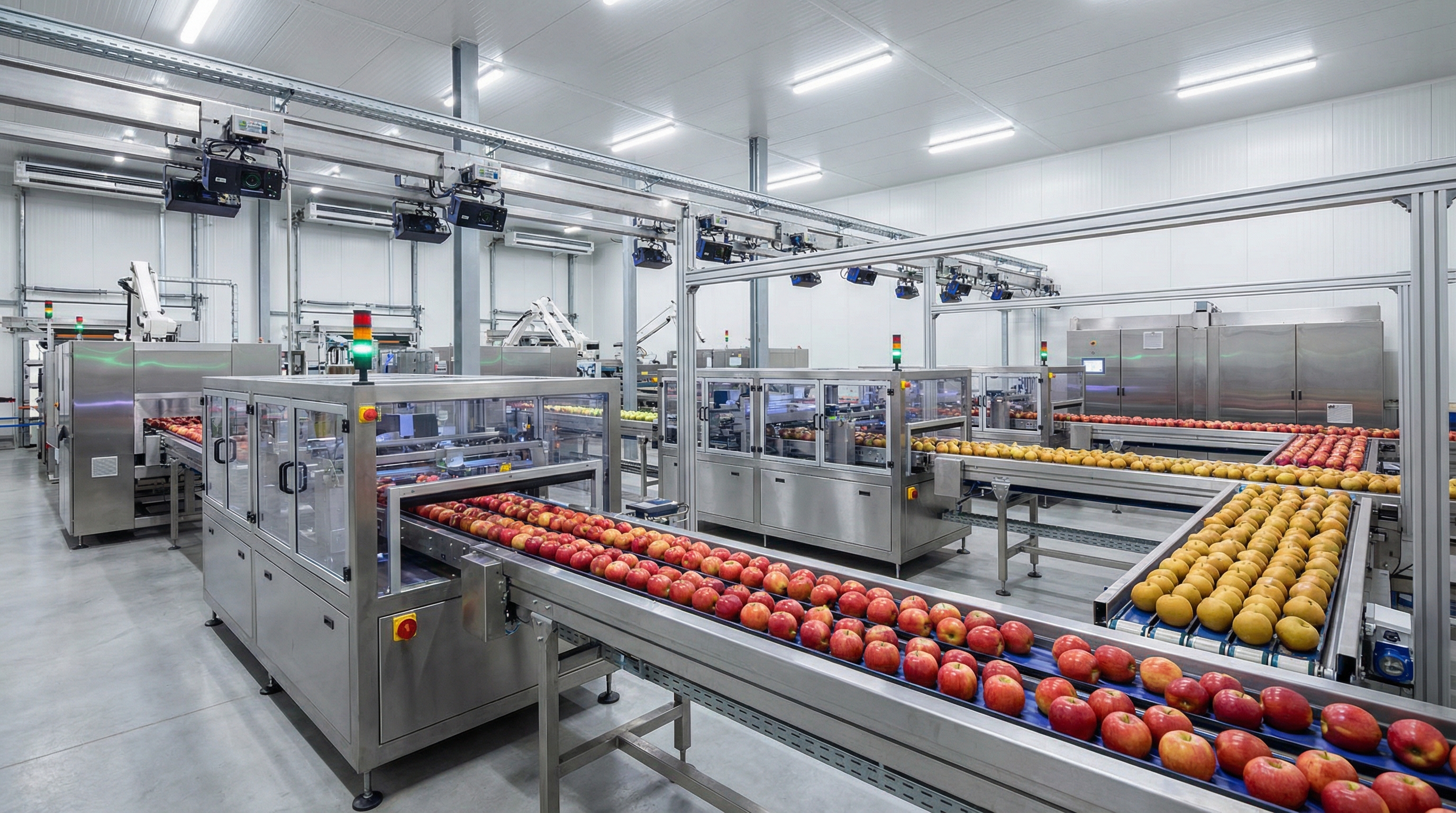
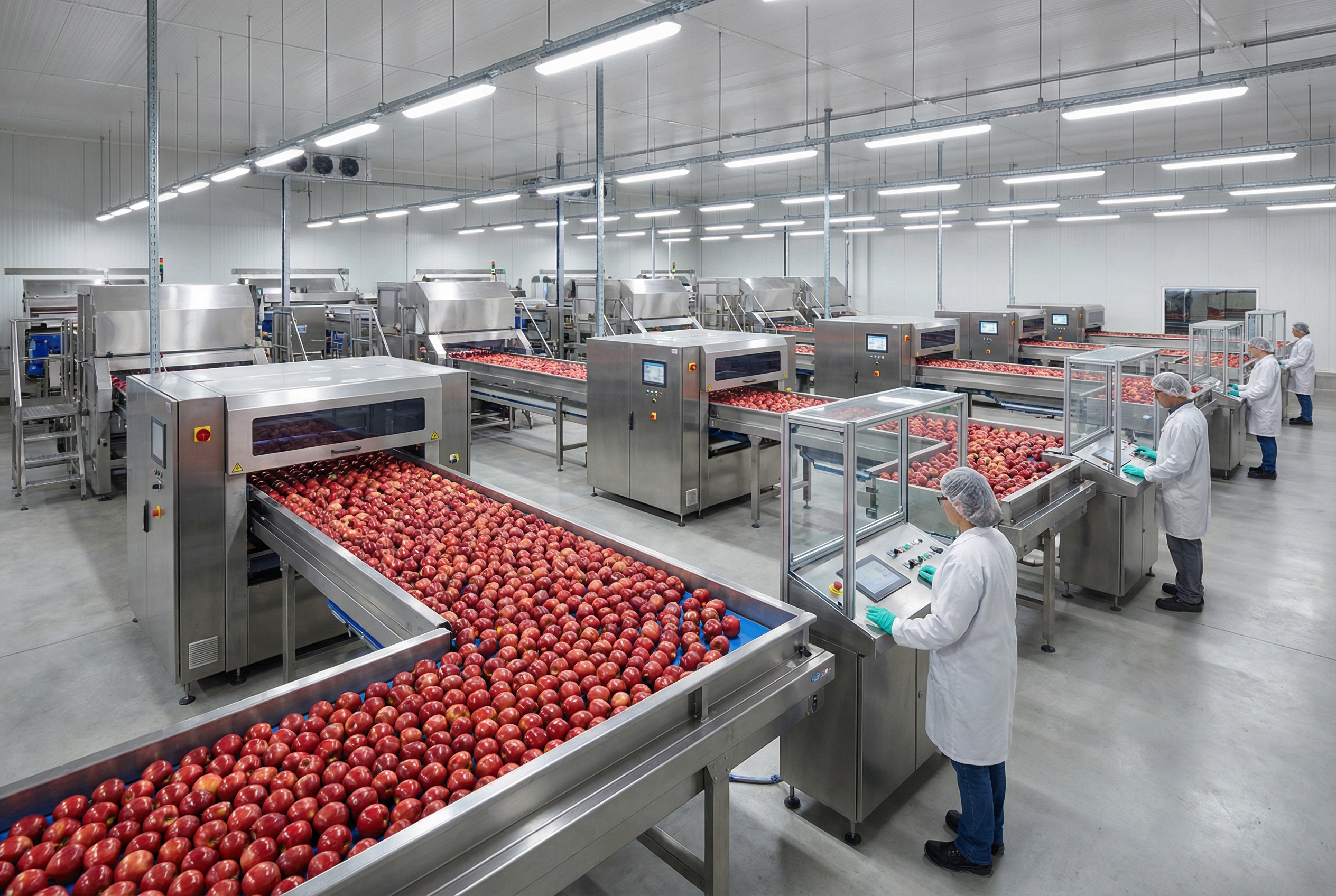
AI-powered automated fruit grading and packing facility with conveyor lines and robotic sorters

The Pack & Keep Environment

Computer vision grading at line speed. Intelligent cold storage governed by IoT sensor meshes and ML spoilage models. Predictive inventory management that links every bin in your warehouse to real-time market demand. From the moment fruit leaves the orchard to the moment it ships, Zooberry keeps it perfect.

Packout Predictor — Computer Vision

A 12-camera inline imaging system captures every piece of fruit in 360 degrees at 200 frames per second. Deep learning models classify defects, estimate size and weight, grade color, and assign USDA-compliant grades—all before the fruit reaches the first divert gate.

Computer vision sorting line with 12-camera array grading apples at 200fps
Computer Vision + Deep Learning

Camera Array & Imaging Pipeline

The Packout Predictor deploys a 12-camera inline system positioned around the packing line conveyor. Each camera captures at 4K resolution (8 megapixels) with a sustained frame rate of 200 fps, ensuring complete surface coverage even at maximum line throughput. Synchronized strobe lighting eliminates motion blur and provides consistent illumination across all spectral bands—visible, near-infrared, and UV fluorescence.

As each piece of fruit enters the imaging tunnel, the full AI grading pipeline executes in under 40 milliseconds:

  • 360-degree surface imaging — All 12 cameras fire simultaneously, capturing the entire fruit surface in a single pass. Point-cloud reconstruction generates a volumetric mesh for precise dimensional analysis.
  • Defect detection CNN — A convolutional neural network trained on 2.4 million labeled fruit images identifies surface anomalies at the pixel level. The model detects eight defect categories: bruise, puncture, stem pull, insect damage, sunburn, bitter pit, watercore, and lenticel breakdown.
  • Size & weight estimation — Stereo-vision depth maps calculate fruit diameter to ±0.5mm. A regression model correlates volume and density profiles to estimate weight within ±2g, eliminating the need for mechanical weigh stations.
  • Color grading — Multi-spectral analysis maps surface color distribution against variety-specific profiles. The system measures blush percentage, ground color, and russeting coverage to quantify cosmetic quality.
  • Grade assignment — All measurements feed into a rule engine calibrated to USDA grading standards. Each fruit receives a grade: Extra Fancy, Fancy, #1, or Utility/Juice. Custom buyer specifications can override or extend the default ruleset.
  • Lane diversion — Pneumatic divert gates activate within 15ms of grade assignment, routing each fruit to the correct packing lane, bin, or juice pathway.
Predictive packout split dashboard overlaid on facility monitoring screens
Predictive Analytics

Predictive Packout Split & Digital Twin Integration

The real power of the Packout Predictor is not just grading—it is forecasting. Before the first bin of the day is dumped onto the line, the system samples incoming loads and generates a predicted packout split across all grade categories. This forecast updates in real-time as more fruit is processed, converging toward final actuals within the first 10% of throughput.

This capability unlocks a critical advantage: real-time sales negotiations. Knowing your grade split hours before sorting completes allows your sales team (or the Sell Environment's Commodity Arbitrage Agent) to lock in contracts, allocate inventory to buyers, and optimize revenue before fruit even hits the pallet.

  • Accuracy — 98.5% agreement with USDA inspector manual grading across a three-season validation study covering 14 apple varieties and 6 pear cultivars.
  • Predictive split confidence — Within ±2.5% of final actual by the time 10% of a lot has been graded.
  • Digital Twin feedback loop — Every grade assignment is written back to the Grow Environment's Digital Twin. The system links field conditions—block, row, rootstock, spray program, irrigation schedule, and harvest date—to pack quality. Over time, this produces a per-block quality fingerprint that informs next season's agronomy decisions.
  • Variety support — Pre-trained models for 40+ commercial varieties including Honeycrisp, Gala, Fuji, Cosmic Crisp, Granny Smith, Red Delicious, Pink Lady, Bartlett, D'Anjou, Bosc, and all major cherry cultivars.

Storage Sentinel AI

A dense IoT sensor mesh monitors every controlled-atmosphere room in real-time. Machine learning models trained on five years of storage data predict days-to-quality-loss and autonomously adjust atmospheric conditions to extend shelf life and prevent spoilage.

IoT sensor dashboard displaying ethylene, CO2, O2, temperature, and humidity readings across CA storage rooms
IoT + Machine Learning

IoT Sensor Mesh & Atmospheric Control

Each controlled-atmosphere (CA) storage room is instrumented with a dedicated sensor mesh measuring five critical parameters continuously:

  • Ethylene concentration — Electrochemical sensors measure ethylene at parts-per-billion (ppb) resolution. Ethylene is the primary ripening hormone; even trace levels can trigger premature senescence in climacteric fruit. The system detects ethylene spikes within seconds of onset.
  • Carbon dioxide (%) — Non-dispersive infrared (NDIR) sensors monitor CO2 levels to ±0.05%. Elevated CO2 inhibits respiration but excess causes internal browning—the system maintains the optimal band for each variety.
  • Oxygen (%) — Paramagnetic O2 sensors measure dissolved oxygen to ±0.1%. Ultra-low-oxygen (ULO) regimes of 0.8–1.2% O2 are maintained for long-term storage of sensitive varieties.
  • Temperature (±0.1°C) — Redundant RTD probes at multiple positions within each room detect thermal gradients. The system alerts on any zone exceeding ±0.3°C of setpoint.
  • Relative humidity (%) — Capacitive hygrometers maintain humidity at 90–95% to prevent moisture loss while avoiding condensation that promotes fungal growth.

Sensor data is transmitted via Modbus RTU, BACnet/IP, MQTT, or custom REST API—accommodating legacy CA controller hardware as well as modern IoT gateways. The Orchard Node aggregates all streams into a unified time-series database with 1-second resolution.

ML spoilage prediction curves displayed on warehouse management terminal
Spoilage Prediction + Automation

ML Spoilage Prediction & Automated Response

The Storage Sentinel AI runs a gradient-boosted ensemble model trained on five years of storage data spanning 12 facilities, 30+ varieties, and over 400,000 individual bin-level quality records. The model ingests current sensor readings, historical trends, fruit maturity at intake (starch index, firmness, Brix), and variety-specific storage profiles to output a continuous prediction: estimated days until quality degradation exceeds market tolerance.

  • Automated atmosphere adjustments — When the model detects adverse trends, it sends commands directly to CA controllers via Modbus or BACnet to adjust the gas mix. Nitrogen flush, CO2 scrubbing, and O2 injection are all managed autonomously within safety limits defined per room.
  • Five-tier alert hierarchyNormal (green, all parameters within spec) → Watch (yellow, trending toward threshold) → Warning (orange, one parameter outside tolerance) → Critical (red, multiple parameters out of spec or rapid deterioration) → Emergency Ventilation (automatic room purge initiated to prevent total loss).
  • DPA and 1-MCP treatment scheduling — The AI recommends optimal application timing for diphenylamine (DPA) anti-scald treatments and 1-methylcyclopropene (1-MCP) ethylene inhibitor based on real-time ethylene readings, incoming fruit maturity data, and variety-specific storage profiles. Scheduling is calibrated to maximize efficacy while minimizing chemical usage.
  • ROI — Facilities running Storage Sentinel AI report a 3–8% reduction in storage shrink, translating to $500–$2,000 in savings per CA room per season. For a 20-room facility, that represents $10,000–$40,000 annually in recovered fruit value.

QR Asset Tracking + Repair Bot

Every physical asset on your operation—from harvest bins to tractor implements—is tagged, tracked, and maintained through an AI-powered asset management system. Photograph a broken part. The AI identifies it, checks stock, and orders a replacement before you finish your coffee.

Mobile device scanning QR code on orchard bin showing full asset history and maintenance log
Asset Intelligence + Computer Vision

Universal Asset Tagging & Instant History

Every physical asset across your operation is tagged with a durable, UV-resistant QR code linked to a persistent digital record in the Zooberry platform. The system tracks bins, ladders, picking bags, sprayer components, tractor implements, forklifts, pallet jacks, cold storage racks, and any other equipment critical to your workflow.

A single mobile scan with any smartphone or ruggedized tablet returns the complete asset profile instantly:

  • Current location — GPS-tagged last-known position updated each time the asset is scanned or detected by a Bluetooth Low Energy (BLE) beacon in the warehouse.
  • Condition assessment — Current rated condition on a 1–5 scale, updated at each scan by the operator or automatically by the Repair Bot's visual inspection AI.
  • Maintenance history — Complete log of all repairs, part replacements, cleaning cycles, and inspection dates with technician notes and photo evidence.
  • Assignment — Which crew, block, or facility the asset is currently assigned to. Chain-of-custody tracking prevents loss and identifies misallocation.
  • Lifecycle analytics — Total usage hours, cycles, or seasons. Depreciation tracking for financial reporting. Replacement cost estimation for insurance claims.
Repair Bot AI identifying replacement part from photograph of broken sprayer nozzle
Repair Bot AI

Repair Bot: Visual Part Identification & Auto-Procurement

When equipment breaks, the traditional workflow is painful: identify what broke, figure out the part number, call the dealer, wait on hold, hope it is in stock. The Repair Bot collapses this entire process into a 30-second interaction.

  • Photograph the broken part — Snap a photo from any angle using your phone. The AI accepts partial views, dirty conditions, and even disassembled components. Multiple photos improve confidence.
  • AI part identification — A visual recognition model cross-references the image against a database of 50,000+ OEM parts spanning major equipment brands including John Deere, CLAAS, Rears Manufacturing, Durand Wayland, Toro, Husqvarna, Stihl, Jacto, and dozens more. The model returns the exact OEM part number, description, and compatible alternatives.
  • Warehouse inventory check — The system instantly queries your on-site parts warehouse for availability. If the part is in stock, it provides the bin location and notifies the maintenance crew.
  • Automated purchase order — If the part is out of stock, the Repair Bot auto-generates a purchase order with your preferred supplier, compares pricing across multiple vendors, and routes for approval based on your configured spend thresholds.

Preventive maintenance extends the Repair Bot beyond reactive fixes. Machine learning models analyze usage hours, vibration sensor data, thermal imaging trends, and historical failure patterns to predict component failures before they occur. The system generates work orders for preemptive replacement, scheduling maintenance during planned downtime to avoid mid-season breakdowns that cost far more than the part itself.
Packing Line Specifications

Technical specifications for the Packout Predictor computer vision grading system.

Metric Specification
Camera Resolution 4K (8 megapixels per camera)
Frame Rate 200 fps sustained capture
Cameras per Lane 12 (synchronized strobe, multi-spectral)
Throughput 15 fruit/second/lane
Defect Detection Accuracy 98.5% (validated across 2.4M labeled images)
Grade Agreement with USDA 98.5% (3-season validation, 14 apple + 6 pear varieties)
Supported Varieties 40+ (apple, pear, cherry, stone fruit)
Integration REST API + Webhook (real-time grade events, batch summaries)

Maximize your packout percentage with AI.

Computer vision grading, intelligent cold storage, and predictive inventory management—unified in a single platform that pays for itself in recovered fruit value.

Get Early Access